


Open Book Collective — Judith Fathallah, Kevin Sanders, Caroline Ball and Joe Deville on supporting diverse long-form open access scholarship without author-facing fees

By Judith Fathallah, Kevin Sanders, Caroline Ball and Joe Deville
This blog post introduces the work of the Open Book Collective (OBC), a charity registered in the UK but with an international membership. Formed in 2022 as part of Community-led Open Publication Infrastructures for Monographs project (2019–2023), which gave birth to the broader Copim community, the OBC builds on collective funding models already used by some medium-sized publishers and infrastructures in Open Access (OA) book publishing (such as punctum books, Open Book Publishers, and OAPEN/Directory of Open Access Books (DOAB)).
The OBC offers an intervention in scholarly publishing that prioritises equity, bibliodiversity and sustainability via collective funding as opposed to book processing charges. Our aim is to extend this community-led, fee-free approach to a broader range of smaller scholar-led presses and service providers committed to equitable OA book publishing – without charging authors or readers.
In this post, we outline OBC’s model and its origins, touch on recent research into the landscape for OA books in Germany, and share a case study from a Copim colleague – Dr. Judith Fathallah – who published her first born-OA monograph with an OBC member press.
What the OBC Does
Open access has grown substantially over the past decades, but much of this growth has centred on journals, often supported by policy mandates and APC-based (Article Processing Charges) systems. Longform publishing has developed more slowly, with community-led Diamond OA book publishing demonstrating some of the most promising alternatives. Diamond models (see e.g. Fuchs and Sandoval 2013) avoid high Book Processing Charges (often €12,000–€18,000), which can entrench inequality by restricting OA publishing to researchers with access to substantial funds.
In the Diamond OA model used by the OBC, neither readers nor authors pay. Instead, institutions, typically libraries, support publishers and infrastructures for a fixed, but potentially renewable subscription period. These costs are equitably shared through banded pricing based on institutional size and resources.
Our aim is to support community-led OA book publishing by undertaking active outreach to library consortia and individual libraries, helping presses to move towards fully OA models while avoiding extractive fees. Rather than positioning the OBC as a commercial vendor, we operate as a collaborative partnership: publishers, service providers, and library supporters all have opportunities to take on governance roles and contribute to strategic decision-making (see figure 1). This ensures that diverse voices shape the future of OA books and that our operations remain accountable to the communities we serve.
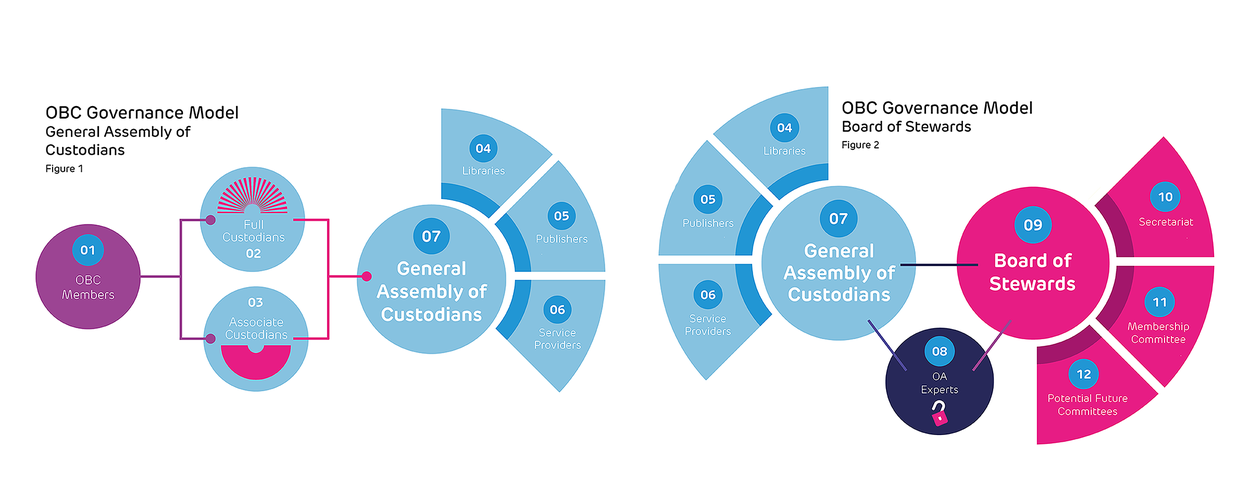
Figure 1: OBC governance model
By supporting publishers and infrastructures rather than individual titles, we create flexible, sustainable options for libraries of many sizes and orientations to support equitable OA publishing.
Streamlining Participation Through Trusted Partners
Where possible, the OBC integrates with trusted third parties such as regional and national negotiators and brokers like IReL (Ireland), Sikt (Norway), California Digital Libraries (working behalf of University of California libraries) and Jisc (UK), reducing administrative barriers for libraries such as complex or time-consuming processes. These consortia facilitate straightforward payment routes and allow institutions to incorporate OBC participation into familiar, established workflows. This approach helps libraries navigate the growing number of Diamond OA offers by consolidating them within a single agreement. The result is a sustainable and predictable revenue stream for scholar-led presses experimenting with fairer publishing models.
Expanding and Diversifying Our Membership
We are actively diversifying the OBC’s membership to reflect a global and multilingual scholarly community. Recent additions include Leuven University Press (Belgium) and Verlag Barbara Budrich (Germany), Helsinki University Press (Finland), Verfassungsblog (Germany), University of Cape Town Press (South Africa) and Edizioni Ca’ Foscari (Venice University Press; Italy). We are also involved in work support collaboration in specific national contexts, for example as part of a project in the Netherlands to work with the Netherlands University Presses (NUPs) to explore how to ‹scale small›. This project is in collaboration alongside colleagues at Thoth Open Metadata, another member of the OBC and part of the Copim community.
Although registered in the UK, our governance structures, our publisher members, and our library supporters all reflect a commitment to open access as a global, community-driven endeavour. The OBC now has over 100 library supporters and has already channelled over €1,500,000 into non-profit OA book publishing. While this is a significant collective achievement, it remains modest relative to the billions extracted from publicly funded research by commercial publishing models – highlighting both the need for alternatives and the viability of community-led ones. Moreover, given the OBC only retains a small portion of these funds, we are still working towards full financial sustainability, as we discuss in a recent report.
Understanding the German Context
As part of our commitment to strengthening collective funding globally, we recently conducted research into the OA book landscape in Europe. This work highlighted several specific challenges in Germany: decentralised research funding at the state level, a particularly intricate and fragmented policy environment, and the availability of DFG BPC funding, which can unintentionally reinforce fee-based OA approaches. The full report is published as ‘Collective funding models for open access books: Librarians’ experiences and barriers to participation across six European contexts’.
Such structural factors can make it harder for Diamond OA models to gain traction. For this reason, we are working closely with several German OA book publishers (the OBC now has three publisher members based in Germany: Verfassungsblog and Verlag Barbara Budrich, as already mentioned, as well as meson press) and a growing group of library supporters in German-speaking contexts (10 libraries, to date) supported by a newly launched German-language version of our website, to advocate for collective funding models that support bibliodiversity and align with the values of community-led open access.
The Collective Development Fund (CDF)
A key way the OBC supports a more equitable global OA ecosystem is through its Collective Development Fund – an annual grant programme for projects that build capacity for OA book publishing. The CDF is funded through optional 5% contributions from our publisher and service provider members.
The fund supports three core areas:
- Developing infrastructures or workflows for distribution, cataloguing, and preservation of OA books
- Building networks and advocacy for OA book publishing
- Developing capacity for scholar-led OA publishing
The CDF is open to applicants worldwide (with the usual legal exceptions), and each round aims to allocate at least 30% of funding to projects based in Lower and Middle Income Countries.
Our first and second round supported seven important initiatives, for example:
- Fostering Academic Self-Reliance in Nigeria through Open Access Books, establishing a sustainable platform for Nigerian scholars and educators
- Enhancing Open Access Book Publishing at Chinhoyi University of Technology Library (Zimbabwe), creating new infrastructure and publishing a series of OA books
- Capacity building for OA academic books for small and medium-sized HEIs in Southwestern Colombia, strengthening capacity for and access to high-quality academic open access (OA) books produced by researchers at several institutions across Colombia
We are currently in the decision-making process for the third round and will announce the results in due course
Case Study: Publishing OA with an OBC Publisher (OBC Research Lead: Dr. Judith Fathallah)
The Open Book Collective also serves important functions for authors. In addition to her work with the Open Book Collective, Judith Fathallah is a scholar of media and cultural studies with specific interests in fan studies, fanfiction gender, popular music, and most recently in new and hybrid forms of true crime media.
Having previously published two fan studies monographs with traditional university presses, Judith was seeking a publisher who not only adhered to the OBC’s standards for production, accessibility, archiving, preservation, and used open licenses, but also had the expertise and subject specialism to understand and engage with her project.
Her first two monographs, Fanfiction and the Author (2017) and Emo: How Fans Defined a Subculture, were in fairly traditional areas of fan studies (fanfiction and popular music respectively). But having been following the resurgence in popularity of true crime in podcast and across other new and hybrid media forms, she had recently conceived the idea of applying fan studies methodologies to forms of fandom the academy has tended to avoid and evade. For example, self-professed fans of celebritized serial killers: a phenomenon which can be reliably traced (at least in proto form) to the expansion of the tabloid press in Victorian England, through the emergence of televised trials in the mid-twentieth Century, to online platforms and use generated content today.
Judith did not think her central thesis – that serial killer fandom, which is variously ironic and self-parodic in much of its expression, is not a comfortably pathologizable Other or opposite to ‹normal› media culture and expression, but the predictable end of a spectrum of engagement with true crime in an intensely mediated culture wherein violence is normalized as spectacle – is particularly controversial. But she knew she needed a specialist in media culture to understand the pitch. Judith found one in Jeff Pooley, Professor of media & communication at Muhlenberg & director of mediastudies.press. The OBC was founded by scholar-publishers and several of our presses are directed by them.
Since the publication of Killer Fandom: Fan Studies and the Celebrity Serial Killer, she has been invited to convene a keynote panel at Fan Studies North America 2024, and founded a research network for scholars interested in the intersections of fan studies, new media, true crime and related fields. In keeping with the OBC’s membership standards for publishers, the book is available OA in multiple formats and as a superbly produced hard copy with colour illustrations. The potentials of OA book publishing allowed for this reach, access, and engagement with hybridity. It would not have been possible without the work of an OA publisher with the understanding and specialism to collaborate on this project. For Judith, one of the most valuable aspects of the OBC is our commitment to bibliodiversity, and to enabling publishers that are small, scholar-led and often specialist to support innovative and/or unusual ideas. Punctum books, for example, has describedhow it is «devoted to academic and para-academic authors working in any field in the humanities, social sciences, fine arts, and architecture & design who want to publish books that are genre-bending and which take experimental risks with the forms and styles of intellectual writing». Humanities scholars often do not have access to BPCs and are less well funded than scientists in general. In this way, the OBC allows libraries to act as true stewards and supporters of innovative scholarship and publications.
Conclusion
By supporting books by authors like Judith, and making them available for free to the global scholarly community, the OBC helps provide authors and readers with new opportunities to engage in cutting edge scholarship, across a range of disciplines, via a fairer, more sustainable funding model. As the range of our activities demonstrate, the Open Book Collective is an intervention in scholarly publishing that seeks to prioritise equity, bibliodiversity, and community governance in doing so. By centring collective funding and supporting non-profit publishers and infrastructures, we demonstrate that OA books can flourish without burdening authors or readers with prohibitive fees. Our work shows that many libraries, publishers, and researchers are eager for alternatives that treat open access as a shared public good.
As we continue to grow, we remain committed to strengthening global partnerships, supporting diverse publishing communities through the Collective Development Fund, and building a future in which OA books are created, supported, and sustained collectively.
To learn more or to get involved, visit www.openbookcollective.org.
Bibliography
Fuchs, C. & Sandoval, M. (2013). The diamond model of open access publishing: Why policy makers, scholars, universities, libraries, labour unions and the publishing world need to take non-commercial, non-profit open access serious. TripleC: Communication, Capitalism & Critique, 11(2), pp. 428-443. doi: 10.31269/vol11iss2pp428-443

Nur der Text ist unter der Lizenz Creative Commons Namensnennung 4.0 International nutzbar
 . Alle anderen Elemente (Abbildungen, importierte Anhänge) sind „Alle Rechte vorbehalten“, sofern nicht anders angegeben.
OpenEdition schlägt Ihnen vor, diesen Beitrag wie folgt zu zitieren:
kaim (31. Juli 2026). Open Book Collective — Judith Fathallah, Kevin Sanders, Caroline Ball and Joe Deville on supporting diverse long-form open access scholarship without author-facing fees. Open Media Studies Blog. Abgerufen am 9. November 2026 von https://doi.org/10.58079/16n80


